Nikon- Af-s Nikkor 85mm F/18g Medium Telephoto Lens Review
This is an in-depth review of the Nikon 85mm f/1.8G prime portrait lens that was announced in January of 2012. The Nikon 85mm f/1.8G is a consumer-grade portrait lens for enthusiasts and seasonal pros that demand quality eyes of a fixed portrait lens at an affordable price indicate. Its big aperture of f/1.8 is great for low-calorie-free photography and the shallow depth of field helps isolate subjects from the background, beautifully rendering groundwork highlights.
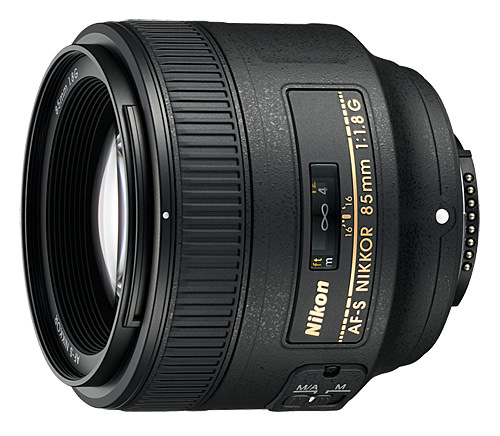
The Nikon 85mm f/1.8G replaces the older Nikon 85mm f/i.8D lens that had been in production since 1994. Compared to the AF-D version that has 6 optical elements in 6 groups, the new 85mm f/1.8G has a very different optical design with 9 optical elements in nine groups. You would call up with and so much drinking glass inside the new 85mm f/1.8G would weigh more than its predecessor, simply in reality, it actually weighs 30 grams less. The lens is designed to work on both DX (cropped-sensor) and FX (full-frame) cameras from Nikon. On DX sensors, the lens is equivalent to a 128mm lens, which is a good range for portraiture, but maybe a picayune besides long for most other types of photography.
But like the onetime Nikon 85mm f/1.8D, the front lens element of the Nikon 85mm f/1.8G does not extend or rotate during autofocus operations, which makes the lens more durable and too makes it piece of cake to use round filters and filter holders. In improver to the above-mentioned optical improvements, the lens incorporates silent wave motor (AF-South), which not but provides well-nigh-silent focus operation just also allows the lens to be fully used on entry-level DSLRs such as Nikon D3100 and Nikon D5100 (the older Nikon 85mm f/1.8D cannot autofocus on entry-level DSLRs without a focus motor). In addition, the AF-Due south motor gives the ability to use autofocus with a manual focus override, which y'all cannot do on any of the AF-D prime lenses.

Just like the older AF-D cousin, the Nikon 85mm f/1.8G also has Super Integrated Coating, which helps reduce lens flare and ghosting. And unlike the 85mm f/1.8D, which had a 9-bract diaphragm, the 85mm f/1.8G has a 7-blade diaphragm. This might sound similar a downgrade, but it is actually non – the vii-blade diaphragm used on modern Nikkor lenses is rounded, while the one-time ones are straight. This means that bokeh on a 7-blade rounded diaphragm lens could actually await as proficient or better than on a 9-blade directly diaphragm. The heptagon-shaped bokeh that is produced by the older lenses is mostly not visible at large apertures and is simply noticeable when stopped down to f/2.8 or more, as seen in the bokeh comparisons below.


In this review, I will provide a thorough analysis of the Nikon 85mm f/one.8G lens, along with image samples and comparisons against the professional person Nikon 85mm f/1.4G and the Nikon 105mm f/two.8G.
Nikon 85mm f/one.8G Specifications
- Mount Blazon: Nikon F-Bayonet
- Focal Length: 85mm
- Maximum Discontinuity: f/i.8
- Minimum Discontinuity: f/16
- Format: FX/35mm, DX
- Maximum Bending of View (DX-format): eighteen°50′
- Maximum Angle of View (FX-format): 28°30′
- Maximum Reproduction Ratio: 0.12x
- Lens Elements: nine
- Lens Groups: 9
- Compatible Format(s): FX, DX, FX in DX Crop Mode, 35mm Moving picture
- Diaphragm Blades: 7 (rounded)
- Distance Information: Yeah
- Super Integrated Coating: Yeah
- Autofocus: Yes
- AF-S (Silent Wave Motor): Yes
- Internal Focusing: Yes
- Minimum Focus Distance: two.62 ft./0.8 chiliad
- Focus Way: Auto, Manual
- G-blazon: Yes
- Filter Size: 67mm
- Accepts Filter Type: Screw-on
- Size: 3.1×two.9 in. / 80x73mm
- Weight: 12.four oz. (350g)
Detailed specifications for the lens, forth with MTF charts and other useful data tin exist found on the Nikon 85mm f/one.8G folio of our lens database.

Lens Handling and Build
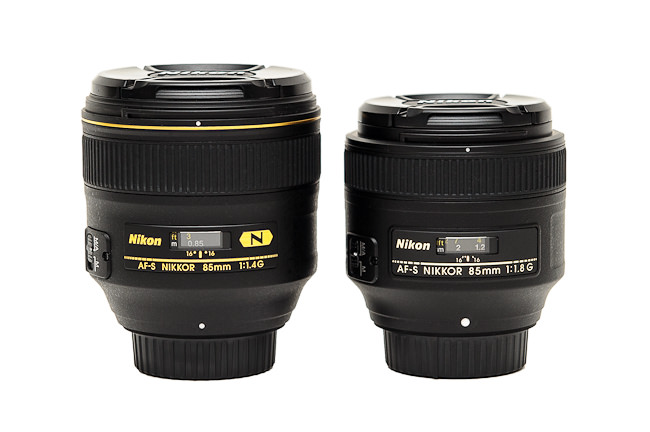
Like to the recently introduced Nikon prime lenses, the Nikon 85mm f/one.8G has a solid build, with a plastic exterior and a metal mount. The changes in optical and butt design increased the size of the lens, which as can be seen below, is a petty smaller and less bulky than the Nikon 85mm f/ane.4G (Left: Nikon 85mm f/1.4G, Right: Nikon 85mm f/ane.8G):
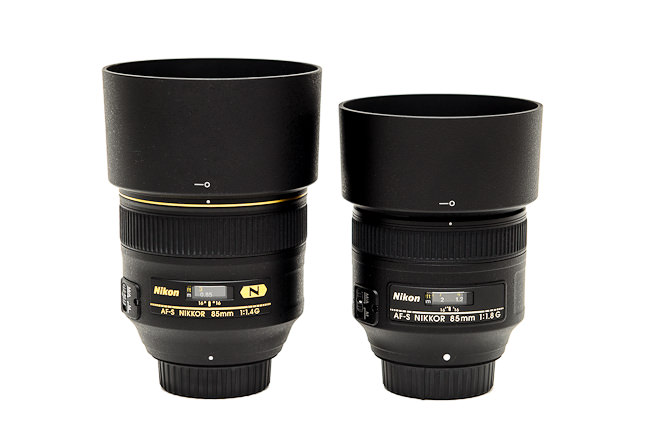
And here is with lens hoods attached to both lenses:
The Nikon 85mm f/i.8G also has a condom gasket on the lens mountain, which provides skilful sealing against dust making its way into the camera. The safe gasket definitely helps not but in reducing sensor dust, merely also in reducing the amount of dust that could potentially finish upwardly inside the lens. Equally I explained in my "what to practise with dust inside lenses" article, it is quite normal for lenses to suck air in and out when focusing or zooming in/out.
The filter thread is also bigger – information technology is at present 67mm, versus the 62mm thread on the 85mm AF-D. This is non practiced news if you already own the older 85mm f/1.8D lens and bought specialized filters – larger 67mm filters would have to be purchased separately. Considering the front element is circular and is recessed within the lens (which is skillful for shooting against the lord's day), it can be difficult to make clean the outer surface area of the lens chemical element that is close to the lens butt. Because of this, I would recommend getting a adept 67mm clear/protective filter such as B+West 67mm MRC articulate filter and get out information technology on the lens at all times. Non only volition information technology help protect the forepart element of the lens and reduce dust, just it volition also brand it much easier to clean the lens when needed.
Despite the bigger size and bulkier lens butt, equally I have already mentioned, the Nikon 85mm f/1.8G is actually 30 grams lighter than its predecessor and well-nigh twice lighter than the Nikon 85mm f/1.4G! It balances really well with any DX camera and information technology feels but right in terms of size, weight and focal length on professional DSLRs similar Nikon D3s also.

I have received several inquiries from our readers about weather sealing on cheaper Nikon prime lenses. The short answer is "No", these lenses are not atmospheric condition sealed. While I accept been using my Nikon 85mm f/one.8G lens in hot/common cold/dry out/wet weather weather condition and have not had any problems, Nikon lenses without gilt rings are not designed to withstand tough weather condition as professional lenses. That'south why Nikon does not specifically mention atmospheric condition-sealing in their marketing materials on these lenses. Another adept news is that the rear element of the lens does non move in and out when focusing, then y'all practise not accept to worry near irresolute the lens focus to infinity when changing lenses (like on the Nikon 50mm f/1.8G).
Equally for the focus ring, information technology is conveniently located on the front of the butt, making information technology easy to manually focus with a pollex and index fingers while shooting images or video. The lens comes with the "HB-62" lens hood, which snaps on the front of the lens and sits tight without wobbling like another Nikon lens hoods. The M/A and One thousand switch on the side of the lens allows autofocus with manual focus override and total manual focus operation. The latest Nikon DSLRs like Nikon D5100 immediately recognize the focus position and provide notifications on the data ("I" button) screen.


Autofocus Performance
I establish autofocus performance and accuracy of the Nikon 85mm f/one.8G to be very similar to the Nikon 85mm f/1.4G. While AF is rather slow to begin with when compared to the older Nikon 85mm f/1.4D), information technology is definitely more authentic, as I take reported in my Nikon 85mm f/1.4G review. The Nikon 85mm f/1.4G seems to exist a tad faster when speedily changing focus from ane field of study to another, although the divergence is not substantial, both in indoor and outdoor environments. Unfortunately, nosotros are non in the same state of affairs as the Nikon 50mm f/one.8G, which significantly outperforms its 50mm f/1.4G counterpart in AF operation.
I tested the AF acuracy of my lens sample with the LensAlign lens scale tool and it turned out to exist a little off, every bit seen from the sample crop from the LensAlign examination:

I personally get bellyaching whatever time a lens has front/back focus issues like this. I do not empathize why manufacturers cannot practice more thorough QA tests before their products are shipped to retailers. We, equally consumers, should be receiving properly calibrated lenses and cameras and not having to deal with testing our gear using focus charts. Unfortunately, these kinds of QA issues happen with all manufacturers, including Nikon. In my experience, however, third-political party manufacturers such as Sigma and Tamron typically take more QA issues (although they both have gotten much improve lately).
As with whatsoever other lens, be careful when shooting at very big apertures in low lite situations. If you cannot consistently get authentic focus in daylight, your lens sample probably has a front/back focusing issue.
Source: https://photographylife.com/reviews/nikon-85mm-f1-8g
0 Response to "Nikon- Af-s Nikkor 85mm F/18g Medium Telephoto Lens Review"
Post a Comment